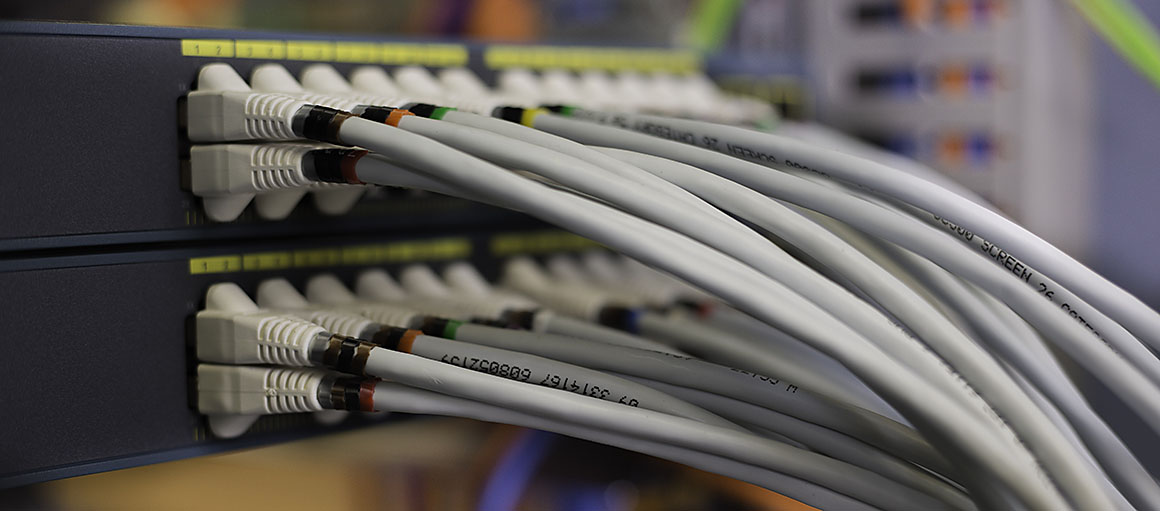
Structured Cabling in a Broadcast Facility

July 2017

Being confronted with a complex nest of cabling, unmarked and undocumented, is the stuff of nightmares for broadcast engineers. Structured cabling design and installation, using standard cabling that can be configured to meet changing requirements, has been adopted in broadcast as it has in ICT to avoid these problems.

dB Broadcast is called upon to advise clients on the best approach to satisfy current and future needs.

Structured cabling has important benefits when installed in a new broadcast facility. It can be installed as part of the building contract rather than by broadcast specialists, and the same type of cable flood-wired throughout a building can carry different signal types for IT, phone, broadcast etc. This all keeps costs down.

Deploying a limited number of different standard cables routed via patching frames makes installations more flexible, and can quickly accommodate additions and developments as infrastructure requirements evolve. Thus a well-designed structured cabling system is an important tool to support enterprise agility and growth.

Designing a structured cabling system increases the Broadcast SI’s engineering time, but it saves on SI wiring time. A well managed, unified cabling system can also reduce maintenance costs.

So what are downsides of this apparent panacea? The simple principle of structured cabling is in stark contrast with the complexity of the many options and technical standards that govern its use!

Although the broadcast industry does not have published standards for cable management, it is often implemented better than in the IT world, as there are accepted practices by system integration companies such as dB Broadcast that specify documentation, cable marking at both ends, cable dressing and harnessing.

Structured wiring systems must be carefully designed as they will typically persist beyond 10 years – a long time in this era of seismic technology change. Getting the design right requires careful long-range technology trend analysis, and translation into practical requirements for the wiring system. When specifying structured wiring requirements during a recent facility build, dB Broadcast dedicated significant effort to trend analysis. This included working with both traditional broadcast vendors as well as vendors driving cutting edge datacentre design. The long-range analysis was complemented by a detailed audit of the connectivity requirements of the various subsystems within the facility.

A structured wiring system makes use of various kinds of cable. Most commonly CAT5e and CAT6 twisted pairs for shorter runs and lower bandwidth links, and fibre – both single mode and multi-mode – for longer runs and high bandwidth links. Single mode fibre can handle greater distances and can handle multiplexed signals, however it has traditionally been avoided within datacentres due to the cost of the associated optics. The development of standards such as PSM4 mean that lower cost, high bandwidth single mode optics are emerging, which is starting to make single mode infrastructure more attractive.

dB Broadcast is experiencing demand from clients for a structured cabling solution that satisfies the need for increased bandwidth. 25Gb/s works well for uncompressed live production technology and live/file based UHD workflows. Structured cabling must be carefully specified and designed to deal with this.

Where a client has commissioned flood wiring for a building, to ensure proper usage, dB is often involved in specifying and managing every patch. An essential step is the deployment of a patch management system to avoid that dreaded undocumented nest of cables that no one dares change!

Despite the advantages of the structured cabling approach, it cannot meet all broadcast cabling requirements. An SI will still need to provide local cabling.

A final point: while structured wiring can provide great flexibility to patch anything anywhere, that doesn’t mean that you should. The design must be aligned with both the network and broadcast design. This is an ongoing process which often involves translating logical design into physical patching, following a coherent scheme that utilises the structured wiring infrastructure efficiently.

Customers won’t thank anyone when they discover that many switch ports they need to access are harnessed at one end of a big row of swing frames, and the rack that their equipment is installed in is harnessed at the opposite end of the row, resulting in congested, unusable trunk channels and another swing frame meme on the Internet.

RECENT NEWS

dB Broadcast to Showcase APIS Hive at IBC 2026

dB Broadcast to Showcase APIS Hive at IBC 2026

dB Broadcast will showcase APIS Hive, its software platform for designing, deploying and managing modern broadcast infrastructures, at IBC 2026.

Developed from dB Broadcast’s experience designing and delivering complex broadcast systems, APIS Hive provides a Single Source of Truth for broadcast and network infrastructure. It can be used across both traditional HD-SDI and AVoIP infrastructures, including large-scale ST 2110 deployments, bringing together device, network and broadcast-specific data within a common platform.

APIS Hive

 APIS Hive applies data-driven and DevOps-style principles to broadcast system deployment. Rather than relying on information held across multiple spreadsheets, drawings and configuration files, infrastructure is modelled as structured data that can be used throughout the system lifecycle – from design and engineering through to deployment, validation and ongoing support.

This approach reduces repetitive manual configuration, improves data accuracy and provides greater visibility of both design intent and the deployed system. Configuration data can also be used to automate the provisioning of devices and network infrastructure, helping engineering teams deploy changes consistently and recover systems more quickly when equipment is replaced or fails.

APIS Hive is also being developed to support software-defined infrastructures, providing the structured data and relationships needed to enable greater automation, orchestration and flexibility.

At IBC, dB Broadcast will demonstrate APIS Draw, which uses Hive data to create and maintain system drawings, and APIS Provisioning, which uses the same model-driven data to support consistent and repeatable system configuration.

By combining broadcast-specific system knowledge with established IT and network automation practices, APIS Hive helps organisations design and operate infrastructure that is easier to understand, deploy, scale and maintain.

Live demonstrations of APIS Hive, including APIS Draw and APIS Provisioning, will be available on the dB Broadcast stand, 10.A30, throughout IBC 2026.

IBC takes place at the RAI Amsterdam from 11–14 September 2026. Register using dB Broadcast customer code IBC1490, or contact sales@dbbroadcast.co.uk to arrange a meeting with the team at the show.

IBC 2026 Registration

dB Sponsors College Sustainability Week

dB Sponsors College Sustainability Week

Students and staff from Hills Road Sixth Form College in Cambridge ran a 4.5km course around the roads of Cambridge as part of their annual programme of sustainability action, called Eco Week.

dB Broadcast is proud to have been one of two companies sponsoring the initiative, and the funds raised will go towards the planting of thousands of trees in Kenya via Just One Tree, a charity removing CO2 from the atmosphere through global reforestation projects.

The fastest 100 participants also received sustainable medals designed to be planted which can grow into wildflowers and support local biodiversity. Well done to all those who organised and took part.


dB Makes Further Key Appointments

dB Makes Further Key Appointments

We are pleased to announce that Pete Whiteway is joining the dB Technology Group as a Senior Systems Engineer. Pete brings over 20 years of experience in broadcast systems integration, technical delivery and support. He has spent many years working with Snell / SAM / Grass Valley on the Kahuna Vision Mixer range, delivering systems and training to clients worldwide. More recently, he has been with ES Broadcast, delivering Cerebrum, AMPP and Ross Video solutions for a broad range of clients.

Alongside his deep technical expertise, Pete has a strong customer-facing background, with particular strengths in delivering end user training and support.

—

In November, dB Broadcast made a number of new appointments of Trainee Installation Technicians. Jack Garnham, Tom Rees, Ollie Holmes, Atorio Harve-Grant, Ethan Palmer and Shaun Mukonda have all joined us, and we welcome them to the team.

This intake is a result of our continued commercial success, and reflects our ongoing commitment to investing in people and maintaining critical skills for the next generation of industry professionals. The technicians are being trained internally according to dB’s own programme, and so are benefiting from the years of experience of our wiring/installation team in house and on client sites.